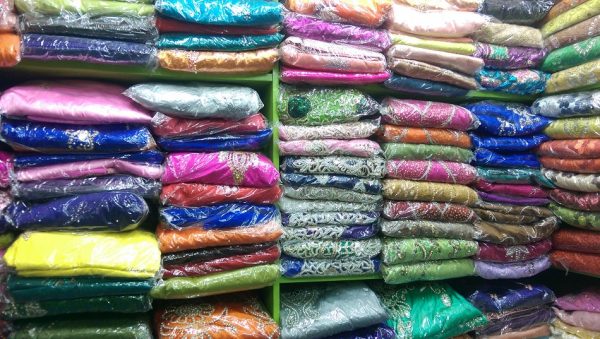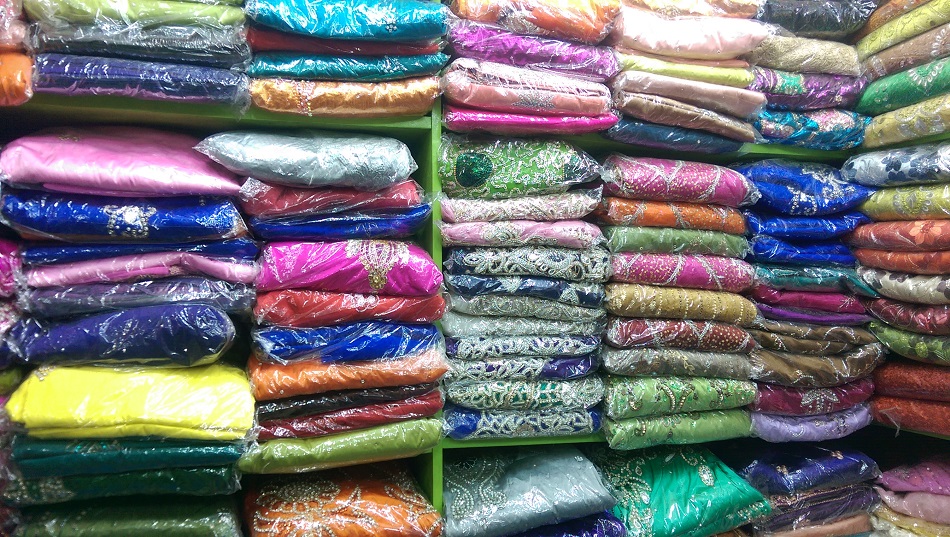
It might mean no big deal for the seasoned cloth merchant or the up-to-date tailor, but those that are not quite conversant with Nigerian fashion may not fully comprehend the variety that greets the eye in local Nigerian cloth markets. Various designs and grades of fabrics have been developed to satisfy wide tastes and suit the pockets of buyers. Here are ten fabric types that are available in Nigeria.
Ankara:

African wax print Ankara is a cotton fabric that is notable for its vividly coloured patterns. They come in different designs and grades and are the most common fabrics you can find in almost every Nigerian market. They are mostly sold in 12 yards or 6 yards. Ways to style Ankara include but are not limited to combining with lace, silk, plain cotton, chiffon or tulle, and embroidered with stones. Manufacturers include Da Viva, Vlisco, and Hi-Target.
Aso oke:
The aso oke, produced by Yorubas, is one of the rare local fabrics that have survived the extinction of indigenously produced Nigerian fashion. It is made from cotton and is sometimes combined with other materials like silk and metallic yarn. It is used in making agbadas and filas (Yoruba men’s gowns and hats) and wrappers (iro) and head ties (gele) for women.
Atiku:

Like brocades, Atiku fabrics are cotton materials. Designs can be plain, stripped, or patterned and they come in grades. Atiku fabrics are sewn as fashionable native wears for occasions by Nigerian men who use it to make the senator and agbada styles, and styles for ladies have been adopted too.
Batik:

Batik is made as adire in Nigeria. Patterns and motifs are created via a dye mechanism in which the cloths are made to resist dyes by tying (adire eleso) or by applying cassava paste (adire eleko). It is used to make buba gowns and dresses and contemporary fashion gowns, trousers and shorts. Chief Nike Davies-Okundaye who is the CEO of Nike Art Gallery, Lagos and who also has established art centres at ogidi in Kogi and Oshogbo in Osun is renowned for her adire style.
Brocades:

Brocades are embroidered cotton materials that are waxed stamped and beaten with clubs to create a shiny look. They are popularly known in Nigeria as Guinea brocade (or sheeda in Hausa) and are usually used to sew free style kaftans.
Chiffon:

This fabric is light weight, slightly rough and comes in different degrees of transparency. Recent casual trends include combining them with Ankara to make gowns and tops or with lace materials for occasions.
Lace:

Types of laces come in a long list some of which include tulle, cord, paper, guipure, sequined, beaded, jute, George, and French laces. Some come in combined colours, or in a combination of types for example tulle and guipure. A fabric of same or contrasting colour with the lace is commonly used as a lining.
Silk:

Easily distinguished by its smooth, slippery and glossy nature, silk is a natural fibre and is a major fabric at an international scale. Though delicate, it is a choice material because it is gentle to the skin and a very comfortable thing to put on. In preference to buying ready-made silk fabrics, Nigerians now show up at their tailor’s with bespoke styles of what they want.
Tulle:

Fine light weight tulle is commonly used in ballet dresses, wedding gowns and veils. Fashion designers in recent times have found a way to incorporate the netting into other materials like laces or in combination with other materials like Ankara to produce uncommon designs.
Velvet:

Velvet is still in vogue though it hit the fashion scene at a high rate about three years ago. It is shiny and has a furry feel.
Feature Photo Credit: Ventures Africa